Why High Clouds Can Leave the Sun Surrounded by a Halo
Learn why high clouds form a 22-degree solar halo, how ice crystals shape its pale ring, and what the sight can—and cannot—tell you about weather.
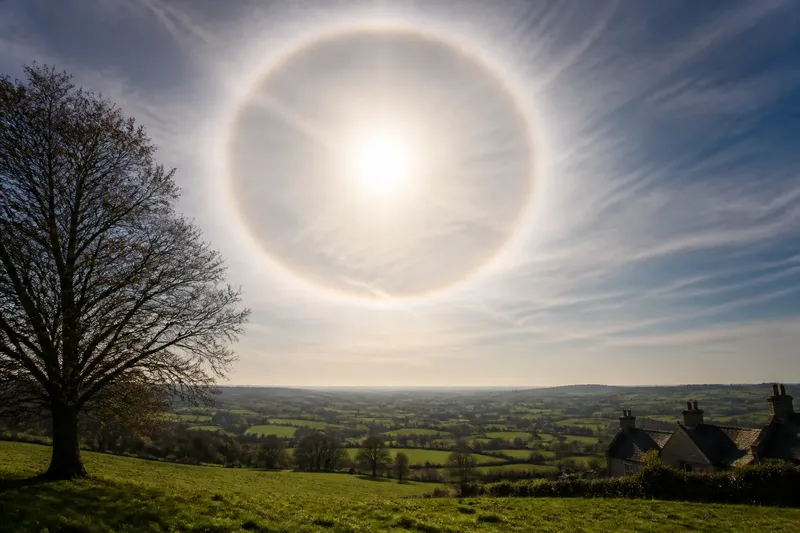
The common mistake with a solar halo is treating it as a forecast: a ring appears, so rain must be next. That shortcut can lead you to read more into the sky than the halo shows. A solar halo forms when sunlight passes through ice crystals in high cloud, and its appearance gives useful clues about the light and cloud above you—not a reliable timetable for changing weather.
What is a solar halo, and where should you look?
A solar halo is a pale, often nearly circular ring around the Sun. The familiar type is called a 22-degree halo because its apparent radius is about 22 degrees: roughly the width of your hand held at arm’s length from the center of the Sun to the ring. The ring may be a complete circle or only a bright arc.
Look for it in thin, high cloud, often called cirrostratus. The cloud can appear as a milky veil across blue sky, or be so subtle that you notice the halo before you notice the cloud itself. The ring’s inner edge may show a faint reddish tint, while its outer edge can look bluish or white; these colors are often subdued compared with a rainbow.
Never stare at the Sun to search for a halo. Instead, block the direct sunlight with a building edge, tree trunk, or your hand without looking around the obstruction toward the Sun. You can also notice a halo when the Sun is behind a suitably placed object, but keep your gaze on the surrounding sky.
How do ice crystals bend sunlight into a ring?
High, cold cloud can contain tiny ice crystals with flat faces and a regular hexagonal shape. As sunlight enters and leaves a crystal through different faces, it changes direction. This bending is refraction, the same broad optical effect that makes a spoon look displaced in a glass of water.
In the common 22-degree halo, a useful simplified picture is sunlight passing through two side faces of a hexagonal crystal. The angle between those faces constrains how far the rays bend. Light that exits at a range of directions near the minimum deflection can reach an observer at about the same angular distance from the Sun, creating a circular concentration of light.
Many crystals contribute at once, but their orientations are not all identical. Flat plates can settle into preferred orientations as they drift, while other crystals tumble. That mix helps explain why a ring can look brighter in some places than others, or why a halo may be incomplete when cloud thickness and crystal alignment vary across the sky.
Refraction also separates sunlight by color because different wavelengths bend by slightly different amounts. The separation is usually modest in a halo, so its colors can be faint. If the cloud is thick, the bright Sun obscures subtle color differences; if the cloud is thin and the sky is clear enough, a trace of color may be easier to pick out.
What details make one halo look different from another?
Start with the ring’s outline. A smooth, broad circle suggests a fairly even veil of ice cloud across the relevant part of the sky. A broken arc may simply mean that the cloud is patchy, that crystals are less effective in one direction, or that part of the ring is lost against bright cloud or background glare.
Then note brightness and color without trying to assign them a forecast. A sharper-looking inner edge, a washed-out outer edge, or a bright patch on one side can reflect changes in cloud thickness, crystal orientation, and the contrast of the surrounding sky. Those features describe the display you can see; by themselves, they do not identify a coming weather system.
The Sun’s height changes the practical view, not the basic explanation. When it is high, the ring can stretch across a wide area of sky, so a clear view may be hard to frame. When it is lower, parts of the circle may be blocked by buildings, trees, or the horizon. Keep a safe viewing angle and let an obstruction shield your eyes from direct sunlight.
What can a solar halo tell you about coming weather?
A halo tells you that ice crystals are scattering and refracting sunlight in cloud somewhere along the line of sight. It often accompanies high, thin cloud, and that cloud can thicken or spread as a larger weather system approaches. But the same visual sign can occur with cloud that changes little, or with a system whose effects arrive much later or miss your location.
That distinction matters: a physical explanation for the ring is not a dependable local forecast. The halo does not reveal how quickly cloud will lower, whether rain will reach your area, or how strong any approaching weather will be. Use it as one observation, then check an official local forecast if you need to make plans.
For a useful sky note, record the time, whether the ring is complete, the amount of surrounding cloud, and how the sky changes afterward. Avoid turning one sighting into a rule. Several observations made in different conditions can sharpen your sense of what the sky looks like before a change, while still leaving the forecast to tools designed to assess weather.
What do observers ask about solar halos?
Is every ring around the Sun a 22-degree halo?
No. The 22-degree halo is the familiar circular ring, but other optical displays near the Sun can make arcs, bright spots, or partial circles. Shape and position help distinguish them, though direct sunlight makes close inspection unsafe.
Why does a halo sometimes have a reddish inner edge?
Different colors of sunlight bend by slightly different amounts as they pass through ice crystals. The red light is bent less than blue light, so red can appear nearer the Sun along the inner edge; haze and glare may make the color hard to see.
Does a bright halo mean rain is certain?
No. Brightness describes the optical display, not the certainty or timing of precipitation. Check a local forecast for decisions that depend on rain or changing conditions.
Can I see a halo at night?
Yes. Moonlight can pass through ice crystals in high cloud and form a lunar halo by the same general process. The Moon’s light is weaker than sunlight, so a night halo often appears pale and less vivid.
How can you make a safe, useful observation?
Keep the observation simple and separate what you see from what you infer. A pocket notebook or a note on your phone is enough; you do not need to look toward the Sun through binoculars or a camera. If you take a photograph, compose it with the Sun blocked by a solid object and follow the device maker’s guidance for solar photography.
- Describe the cloud: Note whether the sky has a thin veil, scattered streaks, or thicker patches around the ring.
- Describe the ring: Record whether it is complete, broken, faint, or bright in particular places.
- Note the light: Say whether you can distinguish color, while remembering that glare can obscure it.
- Record the direction: Write down which part of the sky has the thickest cloud, rather than trying to infer a storm track from the halo.
- Separate observation from forecast: Keep “a pale ring around the Sun” distinct from “rain may arrive.” Check local weather information when the second statement matters.
Say you notice a faint, incomplete ring while a thin veil covers part of the sky. You note the cloud and ring, then check the local forecast before deciding whether to leave an outdoor plan unchanged; the useful result is a recorded observation and a decision based on current weather information, not a prediction drawn from the ring alone.
For your next solar halo, look for the thin high cloud, notice the ring’s shape from a safely shaded viewpoint, and write down what the sky actually does afterward. That habit turns a striking circle into a clearer observation without asking it to promise what the weather will do.