The Rainbow-at-the-End Myth: What a Bow of Colour Actually Shows
A rainbow has no fixed endpoint. Learn how the bow’s position depends on your viewpoint, the Sun, and raindrops—and why it shifts as you move.
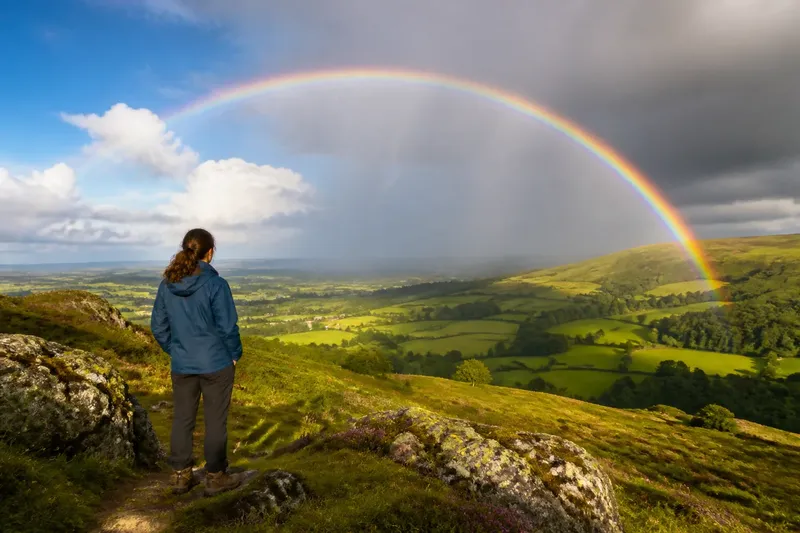
The most common mistake about a rainbow is treating its end as a place on the ground; chasing it can cost you the simple pleasure of seeing how the bow changes with your viewpoint. A rainbow’s apparent position depends on where you stand, where the Sun is, and which raindrops send light toward your eyes. There is no fixed spot where the colours touch down.
Why does a rainbow seem to end on the ground?
A rainbow looks like a coloured arch laid across a landscape because the distant ground provides a convenient visual reference. A hill, field, or line of trees appears to meet the lower edge of the bow, much as the sky seems to meet the land at the horizon. That apparent meeting does not mark a physical boundary.
The droplets producing the visible bow are suspended in the air, often at many different distances. The colours reach your eyes from droplets in a particular direction; droplets elsewhere do not line up with that direction for you. Another observer nearby is looking along different sightlines and may see a bow formed by a different set of droplets.
So the “end” is an effect of the viewing angle, not a target you can walk toward. A change in position changes the geometry, even if the rain and sunlight remain much the same.
How does a rainbow’s geometry depend on you?
For a primary rainbow, sunlight enters a raindrop, bends, reflects inside it, and bends again as it leaves. The outgoing light is concentrated toward your eyes at a particular angle from the point in the sky directly opposite the Sun. This direction creates the curved arc you see against the rain.
That point opposite the Sun is called the antisolar point. If the Sun is behind you, the antisolar point is roughly in front of you, below the horizon when the Sun is high. The bow is centered on that point, so its visible curve occupies the part of the sky opposite the Sun.
Each person has their own antisolar point because it is defined from their own position and line of sight. The droplets that send red light to one observer’s eyes are not necessarily the droplets sending red light to someone standing several steps away. The rainbow therefore belongs to a viewing geometry, not to a single patch of sky.
Why does the bow shift when you move?
When you walk sideways, the direction from you to the antisolar point changes. The set of droplets that sends the right light toward your eyes changes too, so the bow appears to slide across the background. The rain curtain may look stationary while your view of its rainbow moves.
Imagine you are standing beside a wet soccer field with the Sun behind your shoulder and a shower ahead. You notice the lower arc seeming to touch the far goal, then take several steps toward the sideline. The goal remains where it is, but the coloured arc appears to meet the field at a different place because your sightlines now pass through different droplets.
Moving forward toward the apparent endpoint does not bring you closer to a rainbow’s base in the way walking toward a fence would. Your position changes the bow’s apparent placement along with the view. A passenger watching from a moving car may see the arc shift against buildings or hills as the vehicle changes position, while a passenger on the other side sees a different alignment.
What changes the bow’s position and shape?
The Sun’s height matters. With the Sun lower in the sky, more of the circular bow can rise above the horizon; with the Sun higher, the visible arc is lower and may be partly hidden below the horizon. From an elevated lookout, you may see more of the circle than a person standing at ground level, because the surrounding horizon blocks less of the view.
Rain placement matters as well. A bow appears where droplets are present in the direction needed to send light to you. If a rain shaft moves across the landscape, the visible arc can change or fade even when you remain still. Clouds can also block sunlight or cover the relevant part of the rain curtain, interrupting the view.
Colour order offers another clue to the light path. In a primary rainbow, red lies along the outer edge and violet along the inner edge. A fainter secondary bow, when visible, sits outside the primary and reverses that order because light has reflected an extra time inside the droplets.
What do skywatchers often ask about rainbow endpoints?
Can anyone reach the end of a rainbow?
No fixed endpoint exists to reach. The visible bow forms from droplets positioned for a particular observer, so moving toward where it seems to touch the ground changes the view rather than bringing you to a base.
Can two people see the same rainbow?
People beside one another can see bows in the same patch of sky, but each sees light from droplets aligned with their own eyes. The overall shape and location may look nearly alike, while the precise contributing droplets differ.
Why does a rainbow disappear when I move?
Your new viewpoint may no longer align with sunlit droplets in the direction of the bow, or a cloud or shifting rain may interrupt the light path. Moving can also put the Sun in front of you, making the usual arrangement harder to see.
Can a rainbow appear in a sprinkler?
Yes, if sunlight reaches the spray and you stand with the Sun behind you, small droplets can produce a bow. As you move around the spray, its apparent position changes for the same reason it does in rain: the viewing direction selects different droplets.
How can you observe the geometry for yourself?
Look for a shower or spray with sunlight behind you, and note a stable landmark near the apparent lower edge. Then shift a short distance to one side and compare the bow’s alignment with the landmark. Keep looking toward the rain and notice that the colours stay opposite the Sun rather than anchored to the landscape.
For a clearer comparison, ask a companion standing nearby to describe where the bow appears to meet the ground from their position. Their description may differ without either of you being mistaken. You are not locating a distant object; you are describing light arriving along different lines of sight.
That is what a rainbow actually shows: sunlight redirected by droplets into a pattern defined by the observer. The next time the arc seems to rest on a far field, treat that spot as a useful visual marker, not a destination; then watch how the bow shifts when you take a few steps.