When the Moon Became a Calendar in the Sky
Use Moon phases as a sky calendar: learn to recognize the changing shapes, record what you see, and mark the passage of time without relying on exact dates.
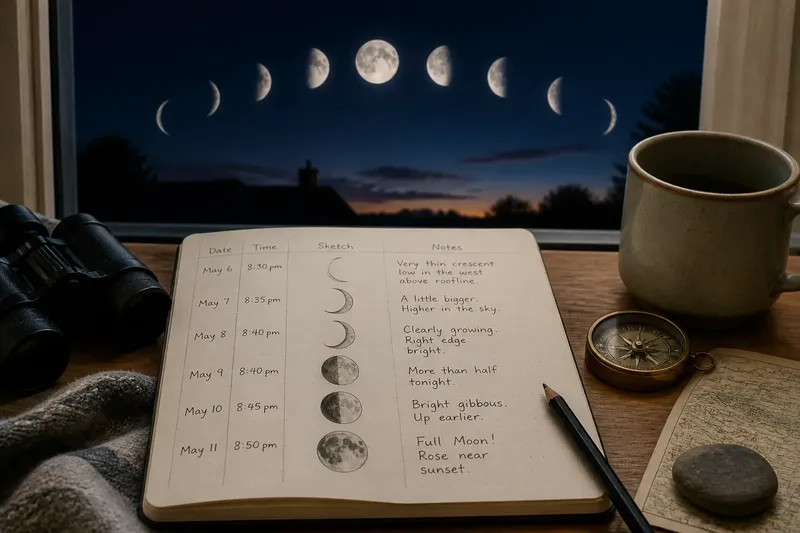
The most common mistake in using Moon phases as a sky calendar is expecting the Moon to appear at the same time or in the same place each evening. That can make the pattern seem unreliable, when the clearer clue is how its illuminated shape changes over time. Moon phases offer a visible way to track passing time without asking the sky to behave like a clock.
How did the Moon become a calendar in the sky?
The Moon became a natural time marker because its illuminated shape changes in a repeating sequence that people can watch with the unaided eye. A thin crescent grows toward a rounded face, then shrinks until it disappears from view, before the pattern begins again.
This cycle is useful for recognizing a stretch of time rather than identifying an exact hour or date. Looking up can tell you whether the Moon is near the beginning, middle, or later part of its familiar sequence, even without knowing every phase name.
That observation can help organize memory: a journey, meeting, or change in the weather happened when the Moon was a narrow crescent or nearly full. The sky does not preserve a written record, but its repeating appearance offers a shared reference point.
What does each Moon phase look like?
The phases describe how much of the Moon’s sunlit half is visible from Earth. The Moon itself is not changing shape; as it travels around Earth, the angle between the Sun, Earth, and Moon changes how much of its lit half faces us.
- New Moon: The sunlit side faces mostly away from Earth, so the Moon is difficult or impossible to see in ordinary conditions.
- Waxing crescent: A slender bright curve appears after new Moon and grows over the following days.
- First quarter: About half of the visible disk is illuminated. “Quarter” refers to the Moon’s place in its cycle, not the fraction of the disk that looks bright.
- Waxing gibbous: More than half the disk appears lit as the Moon approaches full.
- Full Moon: The side facing Earth appears fully illuminated.
- Waning gibbous: The bright portion begins to shrink after full Moon.
- Last quarter: About half of the visible disk is illuminated again, now on the opposite side from first quarter.
- Waning crescent: A narrowing curve remains before the Moon returns to new.
“Waxing” means the illuminated part is growing; “waning” means it is shrinking. Compare the Moon across several observations rather than relying on one glance.
How can you follow Moon phases without a chart?
Choose a place with an open view of the sky and look at roughly the same time on successive evenings when the weather allows. Note the Moon’s outline, whether the bright portion seems to be growing or shrinking, and its general position relative to a fixed landmark such as a roofline or distant hill.
A pocket notebook is enough. Write the date, approximate time, a quick sketch, and a brief weather note. If clouds hide the Moon, record that it was obscured rather than guessing; the next clear view can still show how the cycle has moved.
Say you begin watching just after sunset and see a slim crescent above a roof. You sketch its curve, then return the next evening at about the same time. If the sky is clear, compare the illuminated area without assuming it must look broader: the crescent’s appearance depends on the Moon’s position in the sky and your viewing circumstances, while a phase calendar can help establish whether it is waxing.
Do not treat the Moon’s position as fixed. Its rising and setting times shift through the cycle, and the horizon, buildings, and trees can hide it. A phase sketch is usually a clearer calendar mark than trying to remember where it stood.
Why does the Moon rise at a different time each day?
The Moon moves eastward along its orbit while Earth turns beneath the sky, so Earth must rotate a little farther before the Moon returns to a similar position. As a result, moonrise generally occurs later from one day to the next, though the exact change varies.
This explains why a Moon that was easy to see after sunset one evening may appear later on another. It also explains why the Moon can be visible during daylight: its position in the sky is not tied only to nighttime.
For observation, keep the phase and the time separate in your notes. The phase tells you where the Moon is in its repeating cycle; the time and direction tell you when and where you happened to see it.
What can a Moon phase tell you about the time of night?
A phase gives a rough clue to when the Moon is likely to be above the horizon, but it cannot provide an exact appointment. A new Moon stays close to the Sun’s direction and is hard to see, while a full Moon rises around sunset and sets around sunrise in broad terms.
A first-quarter Moon is often well placed in the evening sky, while a last-quarter Moon is more commonly seen late at night or in the morning. These are useful expectations, not fixed rules for every location or date.
Clouds, hills, buildings, and the observer’s location all affect what is visible. For a specific rise or set time, consult a local sky calendar; for casual timekeeping, let the phase serve as a broad marker.
Why is a lunar cycle not the same as a month on a wall calendar?
The Moon’s phase cycle does not fit neatly into a repeating set of whole days. A phase such as full Moon can fall on different dates from one cycle to the next, so ordinary month boundaries do not consistently align with the sky.
That mismatch is a reminder that a sky calendar and a printed calendar answer different questions. The Moon shows a recurring natural sequence; a civil calendar divides time into named months and dates for shared daily use.
If your goal is to remember a period by what the Moon looked like, record the phase you observed rather than trying to convert it into a tidy month count. The visible pattern is the point.
What questions do observers ask about the Moon as a calendar?
How long does it take the Moon to return to the same phase?
The sequence from one new Moon to the next takes a little more than four weeks. For observing, it is enough to think of this as a recurring cycle rather than a fixed block of calendar days.
Can I see every phase from my yard?
You can see the cycle’s changing appearance when the Moon is above your horizon and the sky is clear, but a new Moon is generally too close to the Sun’s glare to stand out. Trees, buildings, and local weather may also interrupt a particular evening’s view.
Does the crescent always face the same direction?
No. The crescent’s tilt changes with the Moon’s position in the sky and the observer’s location, so it may look like a curved smile, a tilted arc, or a narrow upright shape. Track whether it is waxing or waning by comparing its illuminated area over time, not by expecting one fixed orientation.
Can moonlight tell me the exact date?
Not by itself. A phase can narrow down where you are in the lunar cycle, but it does not identify a unique date without additional information and a reference calendar.
How can you make the Moon’s cycle easier to remember?
Use a small, repeatable observation routine: note the phase, sketch the bright edge, and add one sentence about the sky. Keep the notebook somewhere you will notice it, such as beside a window or near a coat you use for evening walks.
When the Moon is hidden, mark the cloud cover instead of forcing a sighting. After several entries, the pages can show both the lunar sequence and the gaps caused by weather, making it easier to connect a familiar shape with the passage of time.
Moon phases work best as a patient, visual calendar: look for change, record what is actually visible, and let the cycle supply the rhythm. If you need to place an observation on an exact date, pair your notes with a local lunar calendar rather than relying on the crescent’s apparent width or tilt.