A Window-Side Skywatch for the First Clear Evening
A window-side skywatch turns a clear evening into a simple record of twilight color, helping you notice how the view changes without guessing the weather.
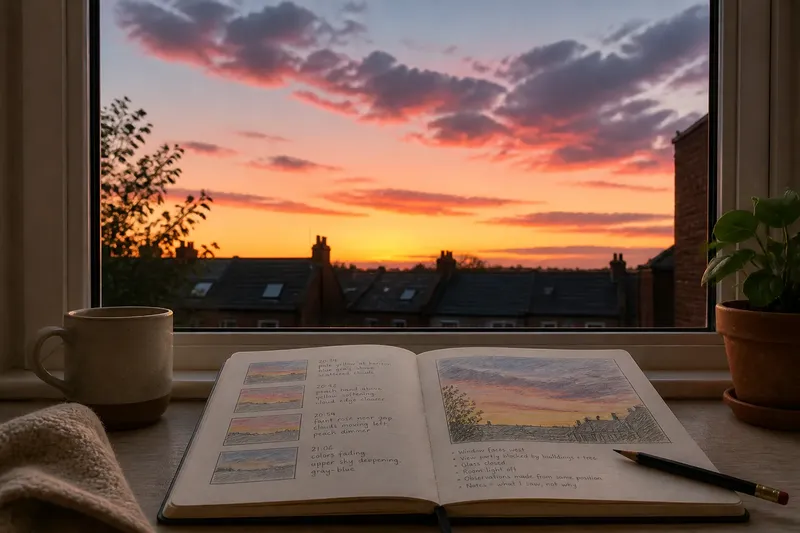
The most common mistake during a first clear evening is to look once, decide the sky is “pink,” and move on; the sequence that led to that color is what you miss. A window-side skywatch gives you a calm way to record twilight as it changes, without turning a striking sky into a weather forecast.
Imagine that you have spent a cloudy stretch mostly indoors. One evening, the western view opens between the neighboring buildings, and the light begins to soften. You have a notebook, a pencil, and a window that looks toward the sunset; the aim is simply to observe, return to the same view, and note what changes.
What should you prepare before twilight?
Choose a window with a clear view of some part of the western sky. It does not need to frame the horizon. A roofline, tree branch, or nearby building can serve as a steady reference, while a view of the sky above it gives you room to watch the color shift.
Set out a notebook and pencil where you can reach them without leaving the window. Use a phone clock only if you want help keeping your observations in order; exact timing is not the point. A small sketch can be more useful than a polished description because it shows where the colors appeared in relation to the horizon and nearby clouds.
Before the light changes much, write down the basics: which direction the window faces, what blocks part of the view, whether the glass is open or closed, and the general sky condition. These details help you compare what you saw at different moments without pretending that your view represents the whole sky.
Keep the setup comfortable. If reflections make the colors hard to see, turn off a nearby lamp or move slightly to one side. Do not stare at the sun; begin observing after it is out of view, and keep your attention on the surrounding sky.
How does a window-side skywatch unfold?
For the invented evening, you settle at the window while the sun is still above the rooftops. You do not need to watch continuously. Instead, make a short note, return after a few minutes, and describe what is visibly different from the same position.
- Make a starting note. Record the visible colors and where they appear: perhaps the horizon looks pale yellow, while the sky above it seems blue-gray. Write “what I see,” not an interpretation of why it looks that way.
- Mark the edges. Notice where one color gives way to another. A transition may be gradual, patchy, or hidden behind a building. In the sketch, use simple bands or shading rather than trying to reproduce the sky exactly.
- Return to the same view. After a short pause, check the same section of sky and compare it with your first note. You might see the yellow soften, the lower sky turn peach, or a cloud’s edge become easier to distinguish.
- Record what moved or faded. Clouds may drift across a colored area, while the color itself may lose intensity. Note each change separately; “cloud moved left” and “pink area dimmed” are clearer than “the sky changed.”
- Finish when the view stops offering new detail. Add a final note about which colors remain and which have faded. The point is to capture a sequence, not to stay until the sky is completely dark.
In this imagined scene, your notes might show pale yellow low on the horizon, a peach band spreading above it, and a faint rose color that appears briefly near a gap in the clouds. Later, the lower colors fade while the upper sky deepens. The useful result is not a forecast; it is a record of what your particular window revealed in order.
What details make color notes useful?
Color words vary from person to person, so pair them with position and comparison. “A narrow orange strip just above the roof” gives another observer more to picture than “beautiful sunset.” You can also describe a color as warmer, cooler, brighter, or more muted than it looked in your previous note.
Keep the language modest. The color you see can be affected by the angle of view, nearby surfaces, window glass, and the brightness of the room. A white wall reflecting sunset light may make the room feel rosy even when that hue is less apparent in the sky.
To keep the record clear, separate observation from interpretation. For instance, write “the cloud underside looked pink” in the observation line, then add “possibly reflecting light from below” as a tentative thought if you want. You do not have to identify the cloud or explain every color.
- Position: Say whether a color sits at the horizon, above a roof, or higher in the visible sky.
- Extent: Note whether it forms a thin edge, a broad band, or scattered patches.
- Change: Compare it with the previous note: stronger, dimmer, spreading, or gone.
- Obstruction: Record when a building, tree, or cloud blocks the area you were watching.
- Viewing conditions: Mention reflections or room lighting if they may have affected what you perceived.
These details give you something to compare on another clear evening without requiring a color chart or technical equipment.
What questions come up during a twilight observation?
Do I need to watch the sunset from the horizon?
No. A partial view is enough if you keep track of what is blocked and return to the same window. The changing light above a roofline or through a gap between buildings can still provide a clear sequence to describe.
Should I name every cloud I can see?
No. For this routine, describe a cloud by its visible position, shape, movement, or color rather than stopping to classify it. That keeps attention on how the scene changes and avoids turning an observation into a naming exercise.
Can a colorful twilight tell me what tomorrow’s weather will be?
This observation routine cannot establish a forecast from color alone. Record what you see, and consult a suitable local forecast if you need to make weather-dependent plans.
What if the colors look different each time I check?
That is useful to record, not a problem to solve. Note the changing view and any difference in your position, room lighting, or window reflections so you can distinguish a change in the sky from a change in how you are seeing it.
How can you learn from the finished notes?
When the evening is over, read the entries in order. Look for the sequence: which color appeared first, where it was strongest, what faded, and whether clouds concealed or revealed any part of the view. Avoid adding a cause if the notes do not support one.
On another clear evening, use the same window and make the same kinds of notes. You may notice that the timing and color arrangement differ, or that the buildings cut off a familiar part of the scene. Those differences are observations, too; no two evenings need to match for the exercise to be worthwhile.
If you sketch, keep the drawing simple and label the direction or a recognizable roofline. A small arrow for cloud movement and a few color words are often enough. The sketch should help you remember the order, not become an art project that pulls your attention away from the changing sky.
What should the record leave you with?
The imagined observer closes the notebook with a short account: the horizon began pale, a warmer band appeared, a cloud briefly took on a rosy edge, and the color later faded. That is a complete result because it says what was visible and how it changed, without claiming that the evening predicts anything.
A window-side skywatch works best when the notes stay close to the view. Keep the notebook beside the window, return to the same patch of sky, and let the sequence—not a guess about tomorrow—be the reason to look again.